Understanding Kilometers and Miles
Ever found yourself staring at a map with distances in kilometers when you're used to miles? It's a common problem, especially when traveling or working with global data. Whether you're planning a road trip, checking the distance between cities, or interpreting geographical information, knowing how to convert between kilometers (km) and miles (mi) is essential. This guide provides a simple, step-by-step approach to mastering this conversion. For a quick conversion, you can also check out this helpful km to miles converter.
The Conversion Factor: Kilometers to Miles and Vice Versa
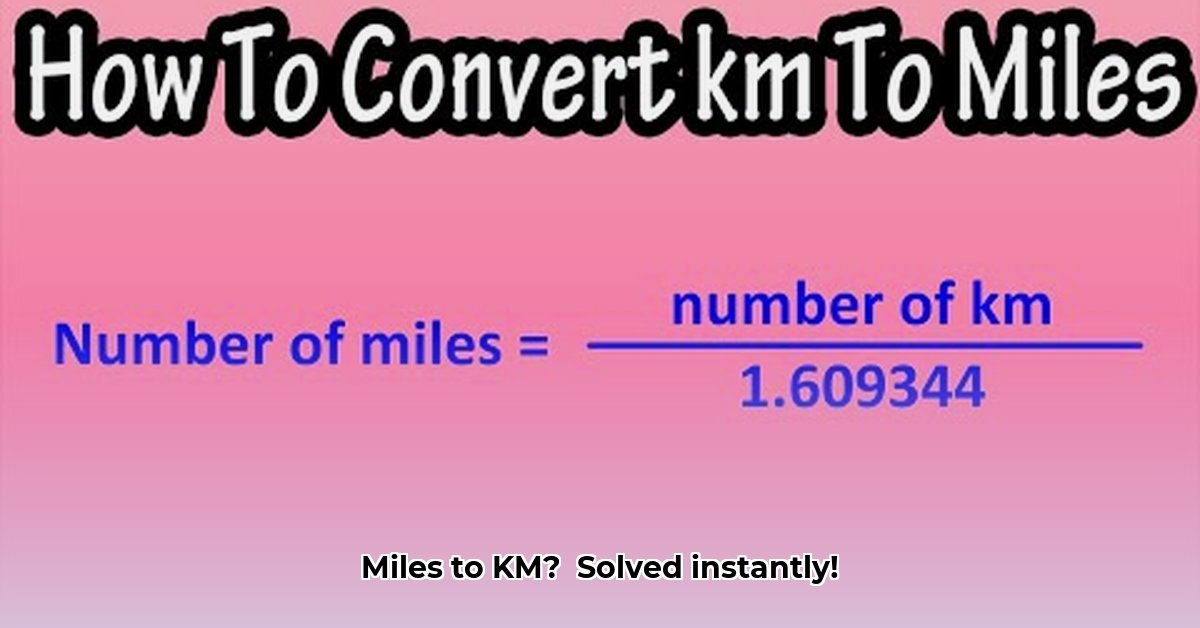
The core of km to miles conversion lies in the conversion factor. One mile is approximately equal to 1.60934 kilometers. For everyday use, 1.61 is a perfectly acceptable approximation. For scientific accuracy, however, use the more precise number. The inverse is equally important: one kilometer is approximately 0.62137 miles (or roughly 0.62 for quick estimations). Choosing between precise and approximate values depends on the level of accuracy required for your specific task. Did you know that a 1% error is generally acceptable for most non-scientific applications? This precision level often suffices for daily use.
Your Easy-to-Use km to miles Conversion Chart
Here’s a handy chart to simplify the process:
| Kilometers (km) | Miles (mi) (approx.) | Miles (mi) (precise) |
|---|---|---|
| 1 | 0.62 | 0.62137 |
| 5 | 3.11 | 3.10685 |
| 10 | 6.21 | 6.21370 |
| 20 | 12.43 | 12.42740 |
| 50 | 31.07 | 31.06850 |
| 100 | 62.14 | 62.13700 |
| 200 | 124.27 | 124.27400 |
| 500 | 310.69 | 310.68500 |
| 1000 | 621.37 | 621.37000 |
To use the chart, locate the kilometer value in the left-hand column. The corresponding approximate and precise mile values are in the adjacent columns. For instance, 50 kilometers is approximately 31 miles or precisely 31.0685 miles. How convenient is that?
Manual Calculation: A Step-by-Step Approach
For those comfortable with a bit of math, manual conversion is straightforward. To convert kilometers to miles, multiply the number of kilometers by 0.62 (or 0.62137 for higher accuracy). To convert miles to kilometers, multiply by 1.61 (or 1.60934 for higher accuracy). For example, converting 150 kilometers to miles: 150 km * 0.62 ≈ 93 miles.
Online Converters: Quick and Easy Solutions
Prefer a quicker method? Numerous online km to miles converters are readily available. A simple online search will yield many reliable options. These tools are particularly useful for quick, one-off conversions.
Real-World Applications: Putting it All Together
The ability to convert between kilometers and miles has many practical applications:
Road Trips: Planning a 1000km road trip? The chart shows this is approximately 621 miles, helpful for fuel estimations and travel time calculations.
Speed Limits: Seeing a 100 kph speed limit sign? That's approximately 62 mph (100 * 0.62).
Map Interpretation: Easily understand distances on maps displayed in either kilometers or miles.
Fitness Tracking: Translate your kilometer-based fitness data into miles for easier comparison.
Conclusion: Mastering the Conversion
Mastering the km to miles conversion empowers you to effortlessly navigate distances regardless of the units used. Whether using a chart, performing manual calculations, or employing an online converter, the process is simple and efficient. Choose the method that best suits your needs and precision requirements. With a little practice, converting between kilometers and miles becomes second nature.
Key Takeaways:
- The conversion factor (1 mile ≈ 1.60934 km) is fundamental.
- A conversion chart offers a quick visual reference.
- Manual calculation provides a deeper understanding.
- Online converters offer speed and convenience.
- Accuracy depends on the context.